
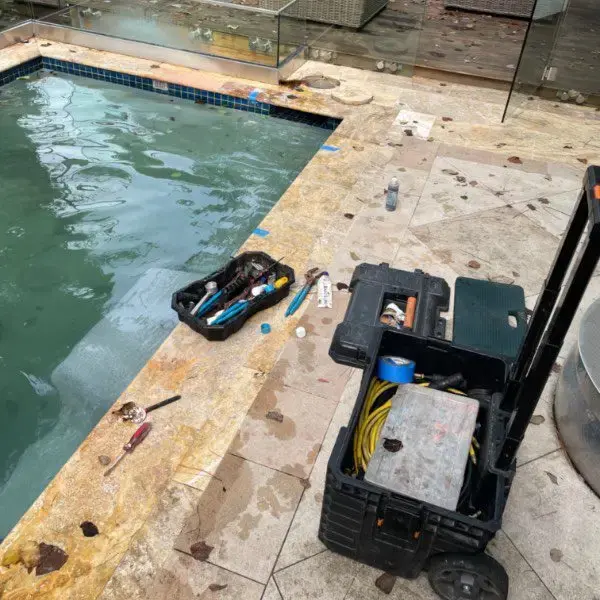
If you've never had pool leak detection done before, the process can sound mysterious — and a little nerve-wracking. It shouldn't be. Here's exactly what happens when we show up.
Before we arrive
We'll ask you a few questions when you book:
- How fast is the pool dropping?
- Did you run the bucket test, and what did it show?
- Any visible wet spots on the deck, the yard, or the equipment pad?
- Any water features (waterfall, fountain, spillover spa) that you've noticed are involved?
We also need the pool full to its normal level and the pump running when we arrive — that's the same state you should be running the bucket test in, so most customers are already set.
Step 1: Equipment pad inspection
We always start at the equipment pad — the pump, filter, heater, and the plumbing manifold. A surprising number of "pool leaks" are actually equipment-pad leaks: pump shaft seals, multiport valve drips, heater fitting leaks. If we find it here, we tell you, quote the fix, and the rest of the test isn't needed.
Step 2: Visual inspection of the pool
We walk the deck, the coping, the waterline tile, and the skimmer mouths. Cracks at the waterline, separated skimmers, and bad return fittings often show up visually if you know where to look.
Step 3: Pressure testing the plumbing
Each plumbing line — skimmer, returns, main drain, cleaner line, spa lines — gets capped at both ends and pressurized with air. We watch the gauge:
- A line that holds pressure is fine.
- A line that drops is leaking, and the gauge tells us roughly how big the leak is.
This is the step that definitively isolates which underground line is the problem. No more guessing, no more digging up the whole yard.
Step 4: Acoustic location
For any line that fails the pressure test, we walk the run with electronic listening equipment. Pressurized air escaping a small hole underground makes a distinctive sound — we can usually pinpoint the leak to within a foot or two.
Step 5: Dye and visual in the pool
For shell leaks (skimmer, lights, returns, cracks), we use non-toxic dye in the water with the pump off. Dye flows toward a leak. Combined with the static water-loss level, we can pin shell leaks down quickly.
How long does it take?
Most jobs: 1 to 2 hours. Big pools, spas, and multi-leak situations can run longer. We tell you up front if we think yours will be on the longer side.
What you get at the end
- A clear explanation of what's leaking and where.
- A written quote to repair it — no upsell, no scare tactics.
- Same-day repair when possible (we carry common parts).
- A guarantee on any repair we perform.
What if it turns out there's no leak?
It happens. Pools can lose water for non-leak reasons — splash-out, an autofill set to overfill, a bad multiport valve seal that wastes water through the backwash line, even kids playing. If we find no leak, we tell you that too, and explain what we ruled out. You don't pay for "results we like."
Book a leak detection appointment or call (281) 252-4233 to get on the schedule. We cover the entire Greater Houston area.