
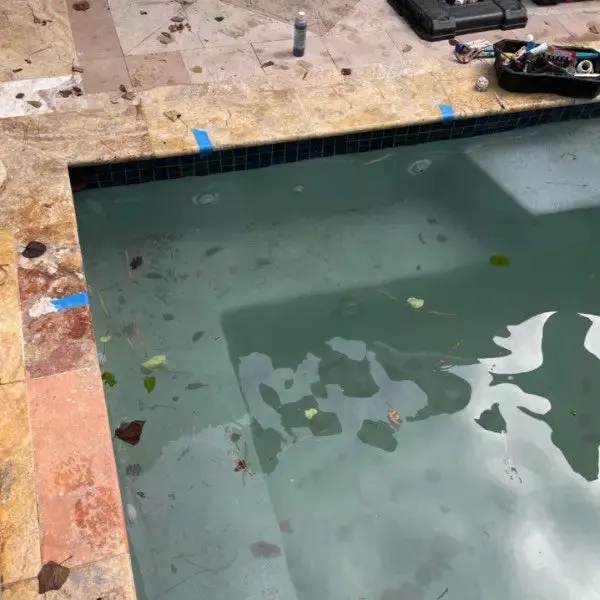
A simple bucket test is the easiest way to tell if your pool is leaking. It takes a minute to set up, runs in the background for a day or two, and gives you a clear answer before you spend money on a service call.
What the bucket test tells you
Pool water and bucket water sit in the same air, sun, and humidity — they evaporate at the same rate. A leak makes pool water drop faster than bucket water, because a leak is on top of evaporation, not instead of it. That's the whole principle.
How to run a pool bucket test (4 steps)
- Fill your pool to the middle of the waterline tile and mark the level with a piece of tape.
- Fill a 5-gallon bucket to the top and place the bucket on the top step of the pool.
- Run your pool for 24 to 48 hours. Turn off any water features — waterfalls, fountains, deck jets, and spillover spas all change evaporation rates and will throw off the result.
- Compare the drops. If the water level in the pool has dropped more than the level in the bucket, you have a leak — and you need professional pool leak detection to find it.
Already seeing a big gap? You don't need the full 48 hours — call (281) 252-4233 or book online.
Reading the result
- Pool and bucket dropped about the same? Evaporation only. Not a leak. In a hot Houston July, that's typically around 1/4" per day — totally normal.
- Pool dropped clearly more than the bucket? That's a leak. The size of the gap tells you roughly how big it is.
- Pool dropped a lot more than the bucket? Don't wait. Call us — significant water loss means significant wasted water, wasted chemicals, and potentially damage to the equipment pad, deck, or surrounding ground.
When to skip the test and just call us
If your pool drops more than an inch a day, your autofill is running constantly, or you can see wet spots on the deck or at the equipment pad, you can skip the bucket test. Those are leak signs already and you'll save 24–48 hours by booking a real diagnosis.
Contact us today or call (281) 252-4233 for quick, affordable, and reliable pool leak detection across the Greater Houston area.
Common bucket test mistakes
- Filling the bucket only partway. It needs to be full to the top so it experiences the same surface evaporation conditions as the pool.
- Leaving water features running. Waterfalls and fountains accelerate evaporation and skew the result. Turn them off for the test.
- Not marking the pool water level. A piece of tape on the waterline tile is your reference — without it, you're guessing.
- Running the test in heavy rain or storms. Wind and rain invalidate the result. Wait for a couple of calm days.
- Not securing the bucket. Kids, dogs, and curious wildlife will knock it over by hour 18. Choose a stable spot on the top step.
A clean bucket test is the difference between a $0 confirmation that everything is fine and a confident "yes, it's leaking — let's find it." If the pool dropped more than the bucket, this test was step one — our full guide on how to find a pool leak walks you through narrowing it down from here. Or skip ahead: book your leak detection appointment and we'll pinpoint the leak.